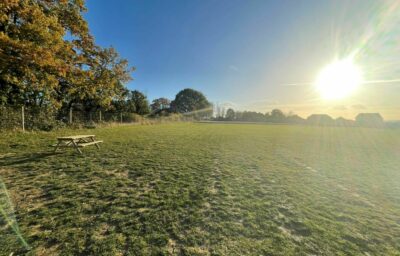
Recall Training in a Secure Dog Field: A Step by Step Guide
You call your dog. They hear you, glance back and carry on. Every owner knows that moment, and on a public walk it can turn into a loose dog, a road or a field of sheep in seconds. Recall is the skill that lets your dog run free safely, and the easiest place to build it is somewhere nothing can go wrong.
A secure, private field gives you that space. Here is how to use it to build a recall you can trust.
Why a secure field makes recall easier
On a public walk you cannot control what happens next. Another dog appears, a jogger runs past or a rabbit breaks cover, and your training falls apart. In a private field you choose the distractions. There are no other dogs in your field for your session, so if your dog ignores you, nothing bad happens. You simply try again.
That safety matters. Every time your dog gets away with not coming back, the habit gets stronger. A secure field lets you practise without those failures.
What you need
- Small, soft, tasty treats your dog really wants.
- A long line, so you can guide your dog back in the early stages.
- One cue, either a word or a whistle, used the same way every time.
- A dog who has not just eaten, so the treats still mean something.
Step 1: Teach the cue at home
Before you go to the field, make the cue mean something good. Say it once, then give a treat straight away. Repeat this 10 times in a quiet room, without asking your dog to move. You are teaching that the cue always means something good is coming.
Step 2: Short distances on the long line
At the field, clip on the long line and let your dog sniff and explore. When they are a few metres away and not busy with something exciting, call once. As they come, praise them, give a treat when they reach you, then release them to play again. Coming back should not mean the fun is over.
Step 3: Add distance
Once your dog is coming back every time at a short distance, let them wander further before you call. If they hesitate, move away from them rather than towards them. Most dogs will follow.
Step 4: Let the line trail, then take it off
When your dog is reliable on the line, let it trail on the ground so you can still step on it if needed. When that goes well, take it off altogether. The fence is there, so a slow return is a lesson, not a risk.
Step 5: Add distractions slowly
Now make it harder, one step at a time. Call your dog away from an interesting smell, then away from a thrown toy. If they struggle, go back a step. Keep each training burst short, then let them play.
Common mistakes to avoid
- Calling again and again. If you call 5 times, your dog learns the first 4 do not count. Call once, then make yourself interesting.
- Only calling at the end. If recall always means the lead goes on and the fun stops, your dog will learn to avoid it. Call, reward and release many times in each session.
- Telling off a slow return. However long it took, your dog came back. Reward it.
- Training for too long. Short bursts, with play in between, work better than one long lesson.
Puppies, rescues and nervous dogs
Start recall early with a puppy, while they still want to stay close. Our puppy recall field page explains how a private field helps. For a rescue or a dog who finds the world worrying, build trust first and keep sessions calm. Our tips for reactive dogs in a private field are a good place to start.
Choosing a field for recall training
For a dog who might jump, pick a field with 6ft fencing, such as Eight Ash Green, Great Bromley, or Fields A and B at Basildon and Upminster. If your dog is not ready for off lead time at all, the Upminster leaded trail, from £7, lets you practise on lead in a private space. Compare every site on our dog fields page.
Book your field in 3 steps
- Pick your field online. It takes about 2 minutes.
- Arrive, go through the gate and shut it behind you.
- Start training, then let them run.